UAE Property Intelligence · 11 October 2026
What Does Your Budget Actually Buy in Dubai? A Practical 2026 Guide
From a first Dubai foothold to premium waterfront homes, this evidence-led guide explains what £200,000, £500,000, £1 million and £1.5 million-plus can realistically target, and the trade-offs behind each brief.
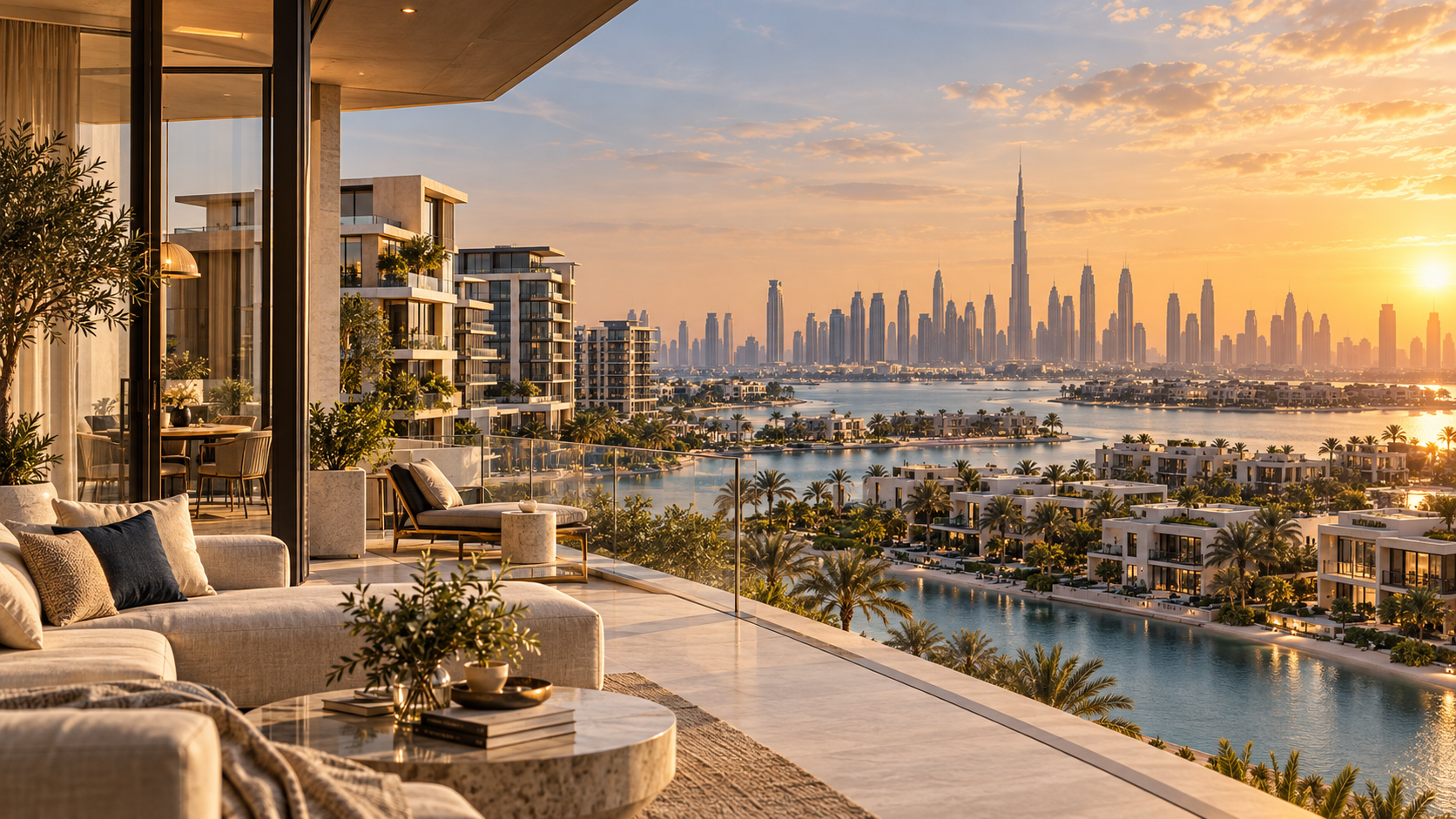
A budget tells us what a buyer can spend. It does not, by itself, tell us what they should buy. In Dubai, the same capital can purchase more internal space, a stronger address, a better view, newer specification, deeper amenities or greater privacy. It rarely purchases all of them at once.
Using an indicative GBP/AED rate of approximately 4.86 on 9 October 2026, this guide translates four sterling budget bands into practical Dubai search briefs. Currency rates, availability and asking prices move continuously, so the figures below are illustrations rather than quotations or promises of stock.
The market context matters
Dubai entered the second half of 2026 with a more selective residential market. CBRE reported that Q2 demand and transaction activity moderated as new supply increased, even while residential values remained higher year on year. That combination matters: buyers may encounter more choice and negotiation in some apartment-heavy locations, while scarce family villas, prime waterfront homes and exceptional units can continue to command strong premiums.
The correct question is therefore not simply, “What can I afford?” It is, “What should this money achieve?”
£200,000–£300,000: approximately AED 970,000–1.46 million
This is generally studio or one-bedroom territory, with occasional larger or alternative-format opportunities depending on age, location, payment structure and completion status.
A buyer prioritising centrality or a premium view will usually accept less internal space. A buyer prioritising size may move to an established secondary community or a developing location. A buyer prioritising new specification may accept a smaller unit or a longer wait for completion.
Bayut’s H1 2026 search data placed Dubai Silicon Oasis among the leading affordable apartment areas and Jumeirah Village Circle among the most searched mid-tier apartment locations. Those labels are useful orientation points, not substitutes for building-level due diligence.
This band can suit a first UAE foothold, rental-led investment or part-time base. The investment case should be assessed on net income after service charges, vacancy, management and acquisition costs, rather than a headline gross yield.
£400,000–£600,000: approximately AED 1.94–2.92 million
At this level, choice begins to open materially. Buyers can target stronger one-bedroom apartments, a broad range of two-bedroom homes, selected larger layouts and some townhouse opportunities in locations where land values are lower.
The main decision is often whether to buy better quality in a smaller format or more space in a less central location. For an owner-occupier, layout efficiency, natural light, storage, building management and the daily journey often matter more than a brochure’s amenity count. For an investor, tenant depth and resale liquidity should carry more weight than novelty.
This band often works well for second-home buyers, professionals seeking a genuine base in the city and investors wanting a wider tenant pool than a highly specialised unit may provide.
£750,000–£1 million: approximately AED 3.65–4.86 million
This is where lifestyle choice becomes much more visible. Depending on the community, the brief can include larger two- and three-bedroom apartments, established family townhouses and entry-level villa options.
Property Finder’s 2026 community data illustrates the spread: Dubai Hills Estate has been associated with a broad AED 3.1 million to AED 7.6 million range, reflecting how dramatically property type, plot, age and exact sub-community affect buying power.
For families and longer-term residents, the search should expand beyond the property itself. School access, commute patterns, landscaping, community maturity, construction exposure and likely service-charge behaviour can materially change the quality of ownership.
£1.5 million-plus: approximately AED 7.29 million-plus
This capital can bring premium waterfront apartments, larger plots, villas, branded residences and ultra-prime opportunities into consideration. It does not remove the need to compromise.
At the upper end, specification, plot position, privacy, service model, view protection and scarcity become as important as square footage. Branded residences can deliver hospitality-led service and international recognition, but they may also carry higher operating costs. Waterfront positioning can protect desirability, yet the quality of the shoreline, access, orientation and future development still require scrutiny.
Knight Frank recorded 296 Dubai residential sales above US$10 million during the first half of 2026, demonstrating continuing depth at the top of the market. That activity does not mean every luxury home is liquid or correctly priced. Exceptional assets and ordinary assets can sit within the same headline price band.
The seven trade-offs behind every shortlist
Space: more square footage usually requires compromise on address, age, view or amenity depth.
Location: a prime address can mean a smaller home, while a growth corridor may buy more space and newer specification.
View: exceptional outlooks can compress internal area for the same budget and may command a lasting premium.
Age: established stock can offer larger layouts; newer stock often prioritises finishes, facilities and efficient communal areas.
Amenities: extensive facilities can improve experience but may increase service charges and reduce usable private space.
Privacy: low-density living, villas and larger plots generally require more capital, especially in mature locations.
Liquidity: mainstream layouts in established, well-connected areas often appeal to a wider resale and rental audience than highly individual homes.
Do not allocate the entire budget to the purchase price
The headline property price is only part of the capital requirement. Buyers should retain an allowance for registration and trustee charges, professional advice, agency costs where applicable, mortgage valuation and arrangement costs, insurance, furnishing, initial service-charge payments and any remedial work.
The correct allowance depends on whether the property is ready or off-plan, cash or mortgaged, directly sourced or transacted on the secondary market. A tailored completion statement should be prepared before the buyer commits.
Build the brief before building the shortlist
A disciplined search begins with purpose: rental income, a city base, a family move, a second home or long-term capital positioning. From there, the mandate should define preferred locations, minimum space, completion status, hold period, financing, acceptable operating costs and the compromises the buyer is genuinely willing to make.
That process reduces noise. It also makes it easier to compare very different opportunities on the same terms.
Give us the brief. We’ll build the shortlist around purpose, evidence and the trade-offs that matter.
Sources and methodology
Market context: CBRE UAE Real Estate Market Review Q2 2026.
Buyer search trends and indicative area segmentation: Bayut Dubai Sales Market Report H1 2026.
Luxury transaction evidence: Knight Frank Dubai US$10 million-plus residential sales analysis, H1 2026.
Community and property-type context: Property Finder UAE and Dubai Real Estate Market Report.
Sterling conversion reference: GBP/AED market data for 9 October 2026.
All sterling-to-dirham equivalents are rounded and illustrative. Property availability, exchange rates, fees and market conditions can change. This article is general property-market information, not legal, tax, mortgage or regulated financial advice.
A private property conversation
Define the brief before choosing the property.
Tell us what you are considering and we will help organise the search around your objectives, priorities and preferred timescale.
Begin a private consultation